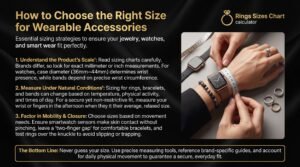
To pick the right size for any accessory, measure the exact spot where it will sit, use a flexible tape or a strip of string, and then add a fit allowance that depends on the item. A ring needs almost no allowance, a bracelet needs about half an inch, and a necklace is chosen by length, not by a snug fit. Get that allowance wrong and the item is either too loose to keep or too tight to wear.
This guide covers rings, bracelets, watches, anklets, and necklaces with real numbers, and explains something most sizing guides never say: how much measuring error each item can survive.
Quick Sizing Guide by Accessory
| Accessory | What to Measure | Fit Allowance |
|---|---|---|
| Ring | Finger circumference or inner diameter | None. Use the exact conversion |
| Bracelet | Wrist circumference, just above the wrist bone | Add about 0.5 inch (13mm) or more |
| Watch | Wrist circumference and wrist width | Strap should allow a finger of space |
| Anklet | Ankle circumference | Add about 0.5 to 1 inch (13 to 25mm) |
| Necklace | Neck circumference, then choose a drop | Length chosen by style, not tightness |
The bracelet allowance of at least half an inch comes from Anne Sportun’s jewelry sizing guide. The anklet range and the watch guidance are common jewelry conventions, not a measured standard, so treat them as starting points and check each brand’s own chart.
Why Rings Are the Hardest to Size
Different accessories forgive different amounts of error, and this explains why a ring is returned more often than a bracelet.
A quarter ring size moves the inner circumference by about 0.6mm. A half size moves it by about 1.3mm. A bracelet allowance of half an inch is about 12.7mm. That means a bracelet has roughly 20 times more room for error than a ring has between two neighboring quarter sizes.
| Accessory | Error That Is Usually Noticeable |
|---|---|
| Ring | About 0.6 to 1.3mm of circumference |
| Watch strap | About one adjustment hole, roughly 5 to 10mm |
| Bracelet | About 6 to 13mm |
| Anklet | About 6 to 13mm |
| Necklace | A whole length category, often 2 inches or more |
These are calculated or approximate figures meant to show scale, not strict rules. The point is practical. If you are sizing a ring, a sloppy measurement costs you. For a bracelet, a quick measurement is usually fine. Our guide on whether a quarter ring size makes a difference shows how small that margin feels on a finger.
How to Size a Ring
Rings are measured as a circumference or an inner diameter, and both convert to the same size. Our guide on whether ring size is based on diameter or circumference explains why the two numbers look different. A few reference points:
| US Size | Inner Diameter | Inner Circumference |
|---|---|---|
| 5 | 15.7mm | 49.3mm |
| 6 | 16.5mm | 51.9mm |
| 7 | 17.3mm | 54.4mm |
| 8 | 18.1mm | 56.9mm |
| 9 | 18.9mm | 59.4mm |
To find your own size, you have three good options:
- Measure with string or paper. Our guide on how to measure ring size at home covers the method.
- Use a tape measure. Our walkthrough of measuring ring size with a tape measure works if you have one at hand.
- Use a ring sizer. See our guide on how to use a ring sizer, or our guide to getting an accurate ring size without a sizer.
Then convert your reading with our free ring size calculator, which gives US, UK, EU, and Japan sizes. Three details catch people out:
- Time of day matters. Fingers swell and shrink, so measure in the afternoon at room temperature. Our guide on how much ring size fluctuates shows the typical daily swing.
- Width changes the fit. A wide band feels tighter than a thin one at the same size, so many people go up a quarter size.
- Each finger differs. Our breakdown of how much ring size varies between fingers shows why a size borrowed from another finger can be off.
If you buy from different brands, remember that a labeled size can fit differently. Our guide on whether ring sizes vary by brand explains why. For a pair of bands, our wedding ring size chart covers both sizes, and our Japan ring size chart helps if you are ordering from Japan.
How to Size a Bracelet
Wrap a flexible tape measure or a strip of paper around your wrist, just above the wrist bone, then measure the tape or paper against a ruler. Add an allowance, since a bracelet at your exact wrist measurement is a tight bracelet.
| Fit Style | Allowance Over Wrist Measurement (Common Convention) |
|---|---|
| Snug | About 0.25 to 0.5 inch (6 to 13mm) |
| Comfortable | About 0.5 to 1 inch (13 to 25mm) |
| Loose or with dangling charms | About 1 to 1.5 inch (25 to 38mm) |
Anne Sportun advises choosing a bracelet at least half an inch bigger than your wrist measurement, which matches the comfortable range above. The snug and loose bands are common retailer conventions, so use them as a guide. A bangle is the exception, because it must slide over your hand. Measure the widest part of your hand across the knuckles and thumb, folded together, and choose a bangle whose inner diameter clears it.
How to Size a Watch
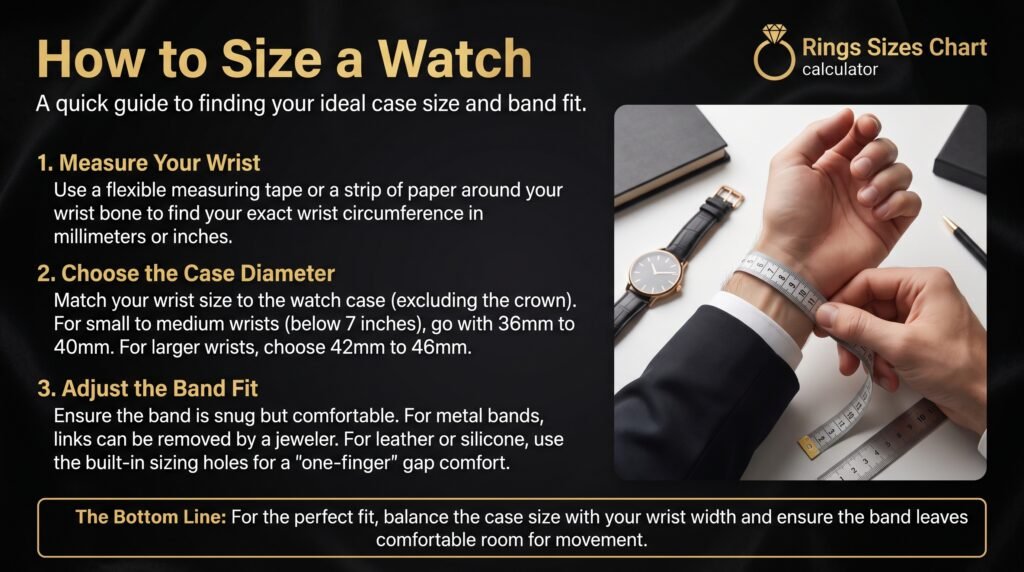
A watch needs two checks, not one: strap length and case size. Measure your wrist circumference for the strap, then check that the case sits within the width of your wrist without hanging over the edges. For fit, you should be able to slide one finger under the strap. A watch that spins freely is too loose, and one that leaves marks is too tight. Metal link bands can often be shortened by removing links, and leather or rubber straps use adjustment holes, so a half hole error is usually forgiving.
How to Size an Anklet

Measure your ankle at the point where the anklet will rest, usually just above the ankle bone, then add roughly half an inch to an inch. Anklets sit loose by design, and they catch on clothing more than bracelets do, so err slightly large and avoid fragile clasps if you are active.
How to Size a Necklace
Necklaces work differently, because length controls where the piece falls, not how snug it is. These lengths are widely used by jewelers, though exact names vary by brand.
| Style | Typical Length | Where It Sits |
|---|---|---|
| Choker | 14 to 16 inches (36 to 41cm) | Around the base of the neck |
| Princess | 17 to 19 inches (43 to 48cm) | At or just below the collarbone |
| Matinee | 20 to 24 inches (51 to 61cm) | Between collarbone and bust |
| Opera | 28 to 36 inches (71 to 91cm) | At or below the bust |
| Rope | 36 inches and longer (91cm and up) | Long enough to wrap or knot |
To find your base number, measure around the neck where the chain will sit and add 2 to 4 inches for a choker style, or choose by where you want the pendant to land. Neck width, clothing neckline, and pendant size all change how a length looks, so try a length against your collar before ordering.
Sizing Mistakes That Cost Returns
| Mistake | Why It Happens | Fix |
|---|---|---|
| Sizing a ring when your hands are cold or hot | Fingers shrink in cold and swell in heat | Measure at room temperature, in the afternoon |
| Measuring a bracelet with no allowance | Exact wrist size is a tight fit | Add at least 0.5 inch |
| Ignoring band width | Wide bands feel tighter | Go up a quarter size for wide rings |
| Using a size chart in the wrong units | Charts mix inches, centimeters, and millimeters | Check the unit before you read |
| Mixing body and product measurements | Some charts list wrist size, others list the piece | Read the chart’s label |
| Trusting one measurement | One reading can be off | Measure two or three times |
Body Measurements or Product Measurements?

This is a common trap. A chart might say “6.5 inches” and mean either a wrist size or the actual length of the bracelet. Before you rely on a chart, find out which it is. If a chart lists the product size, compare it to your wrist plus the allowance from the table above. If it lists the body size, the brand has already built in the fit.
Adjustable or Fixed Sizes?
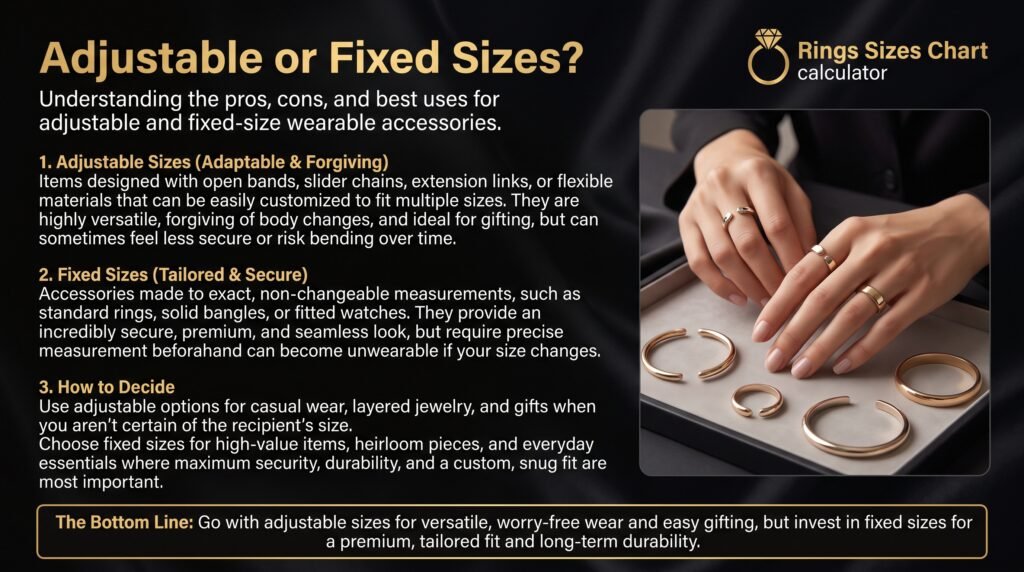
Adjustable pieces, such as slider bracelets and extendable chains, are more forgiving, which suits gifts or layering. Fixed pieces fit better when measured well but have no second chances. Rings are the clearest case, since they are usually fixed. If a ring runs slightly loose, sizing beads offer a reversible fix, and our guide on removing ring sizing beads explains how they come out later.
Frequently Asked Questions
How do I know what size accessory to buy?
Measure the exact spot where the accessory will sit with a flexible tape or a strip of string, then add the fit allowance for that item. Check the brand’s chart to see whether it lists body or product sizes.
How much bigger than my wrist should a bracelet be?
At least half an inch (about 13mm) bigger than your wrist measurement, according to Anne Sportun. Many people choose between half an inch and one inch for comfort.
How do I measure my wrist for a bracelet?
Wrap a flexible tape or paper strip around your wrist just above the wrist bone, mark where it meets, and measure it against a ruler.
Why are rings harder to size than bracelets?
A quarter ring size changes the circumference by only about 0.6mm, while a bracelet allowance is about 13mm, so rings leave roughly 20 times less room for error.
What necklace length should I choose?
Choose by where you want it to fall. A choker runs 14 to 16 inches, a princess length 17 to 19 inches, a matinee 20 to 24 inches, and an opera length 28 to 36 inches.
Should I size up for wide rings?
Often yes. A wide band feels tighter than a thin one at the same labeled size, so many jewelers suggest going up a quarter size for bands wider than about 6mm.
Final Thoughts
Good sizing comes down to two decisions: measure the exact spot, and add the right allowance for the accessory. Rings need precision and almost no allowance, bracelets and anklets need about half an inch or more, and necklaces are about choosing a length that falls where you want it. When you are unsure, use the brand’s own chart, measure at a calm time of day, and confirm your ring size with our calculator before you place the order.