
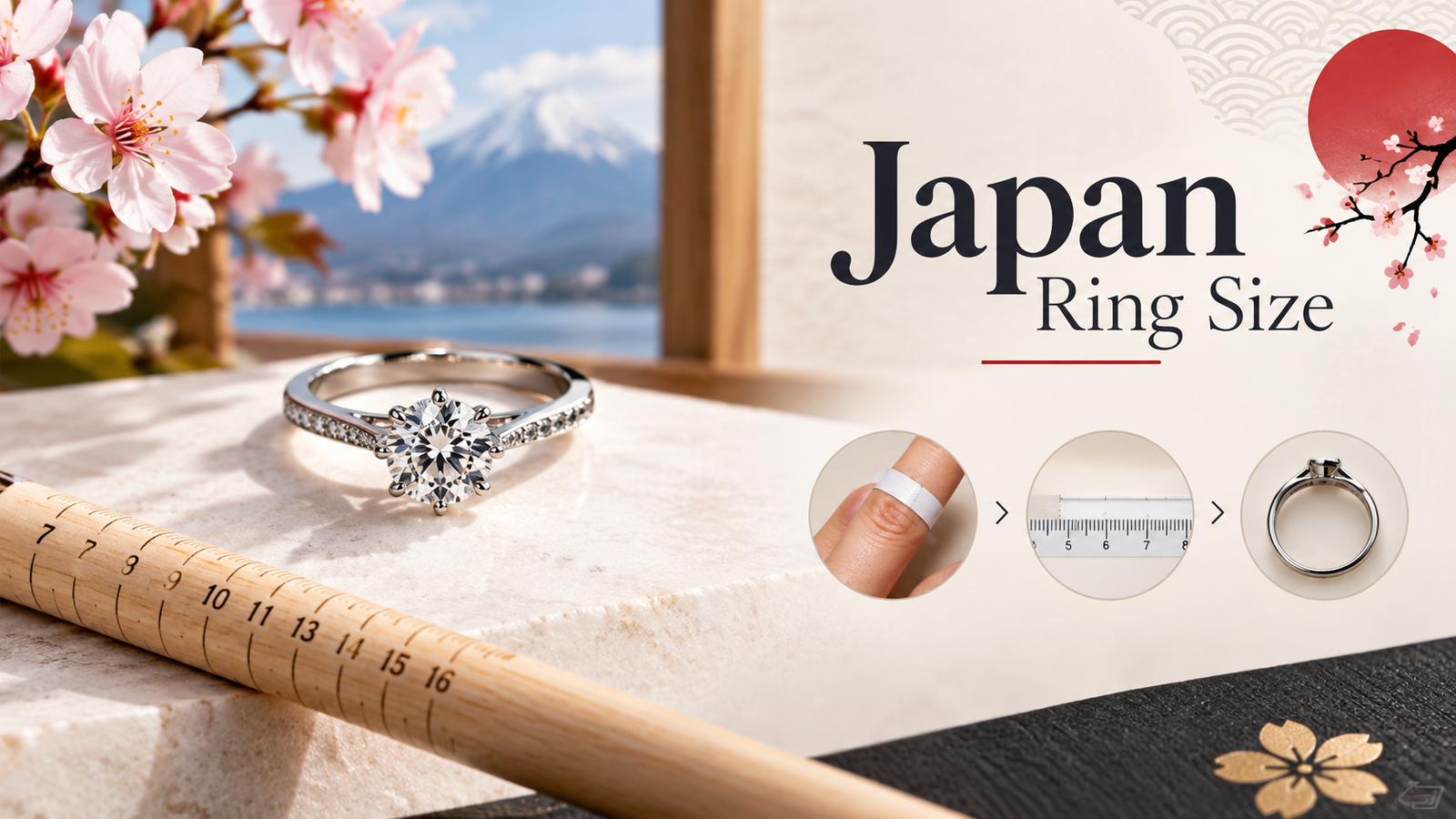
Japan uses a numeric ring sizing scale that runs from around size 1 up to size 30, with the number increasing in step with the ring’s inside circumference. There are no letters and no half sizes to worry about, just a single number that gets larger as the ring gets bigger. Use the chart below to convert any Japan size into its US, UK, or EU equivalent.
Unlike the US system, which uses whole and half numbers, or the UK system, which uses letters from A to Z, Japan relies on a simple ascending scale based directly on inside circumference in millimeters. A Japan size 9 ring and a Japan size 19 ring are measuring the exact same thing, a Japan size 19 is just larger.
This same style of numeric scale is also common across other parts of Asia, though the exact reference points can shift slightly by country and even by individual jeweler, so it is worth confirming locally if you are buying outside Japan itself.
Each Japan size below is matched to its inside diameter, inside circumference, and the closest US, UK, and EU equivalents.
| Japan Size | US Equivalent | UK Equivalent | EU Size | Inside Diameter | Inside Circumference |
|---|---|---|---|---|---|
| 4 | US 3 | F | 44 | 14.1 mm | 44.2 mm |
| 5 | US 3½ | G | 46 | 14.5 mm | 45.5 mm |
| 7 | US 4 | H | 47 | 14.9 mm | 46.8 mm |
| 8 | US 4½ | I | 48 | 15.3 mm | 48.0 mm |
| 9 | US 5 | J | 49 | 15.7 mm | 49.3 mm |
| 10 | US 5½ | K | 51 | 16.1 mm | 50.6 mm |
| 12 | US 6 | L | 52 | 16.5 mm | 51.9 mm |
| 13 | US 6½ | M | 53 | 16.9 mm | 53.1 mm |
| 14 | US 7 | N | 54 | 17.3 mm | 54.4 mm |
| 15 | US 7½ | O | 56 | 17.7 mm | 55.7 mm |
| 17 | US 8 | P | 57 | 18.1 mm | 57.0 mm |
| 18 | US 8½ | Q | 58 | 18.5 mm | 58.3 mm |
| 19 | US 9 | R | 60 | 18.9 mm | 59.5 mm |
| 20 | US 9½ | S | 61 | 19.3 mm | 60.8 mm |
| 22 | US 10 | T | 62 | 19.7 mm | 62.1 mm |
| 23 | US 10½ | U | 63 | 20.1 mm | 63.4 mm |
| 24 | US 11 | V | 65 | 20.5 mm | 64.6 mm |
| 26 | US 11½ | W | 66 | 20.9 mm | 65.9 mm |
| 27 | US 12 | X | 67 | 21.3 mm | 67.2 mm |
| 28 | US 12½ | Y | 69 | 21.7 mm | 68.5 mm |
| 29 | US 13 | Z | 70 | 22.1 mm | 69.7 mm |
EU sizes are based directly on inside circumference in millimeters, which is why the EU number closely tracks the circumference column above.
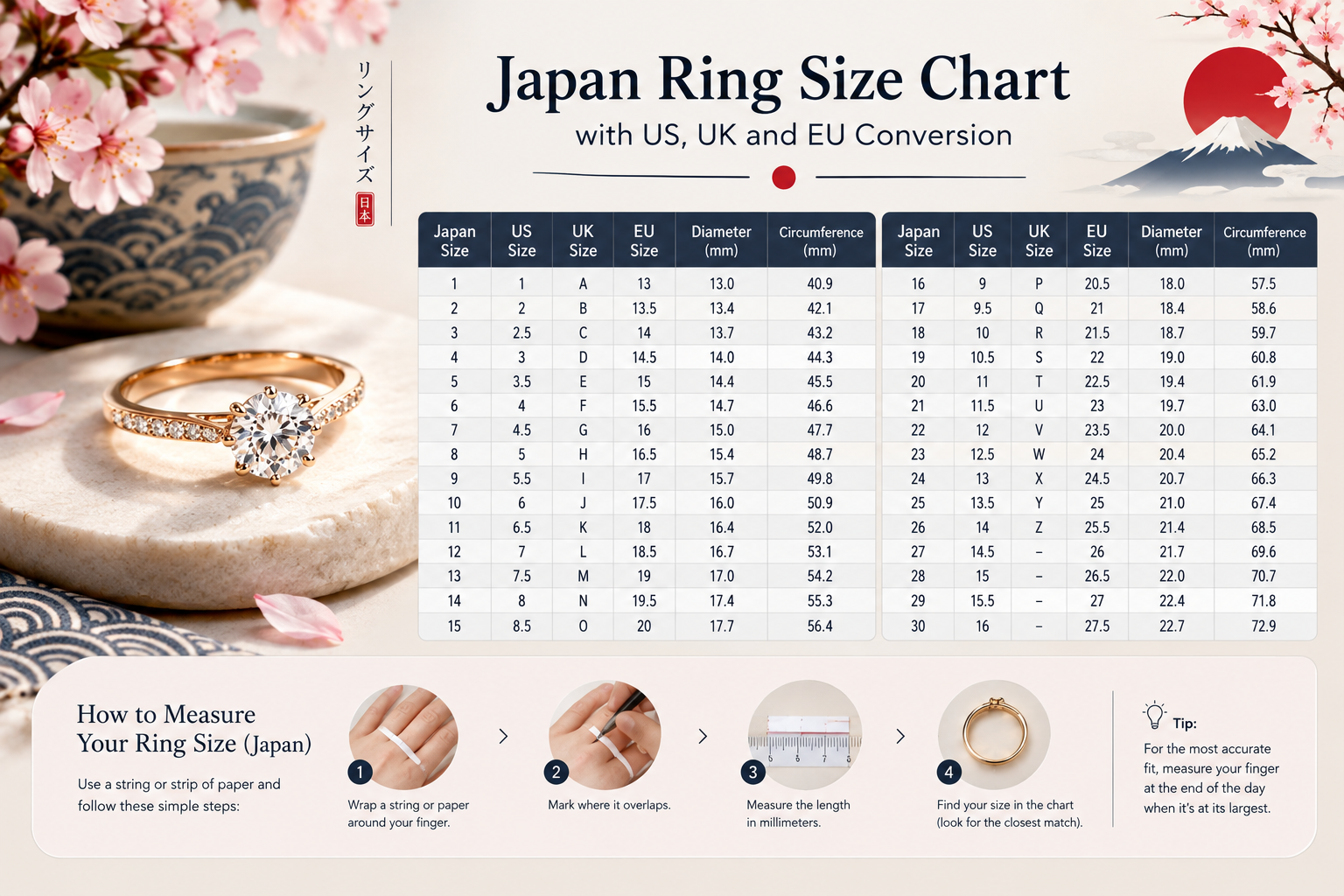
For a fast lookup without scanning the full table:
Every other size and its exact conversion is available in the complete chart above.
While finger size varies from person to person, general averages can help as a starting reference point.
These figures are general guidance only. Measuring your own finger remains the most reliable way to find your exact size.
For the most accurate reading, measure your finger later in the day rather than first thing in the morning, since temperature and time of day can genuinely affect the result. Fingers tend to be slightly smaller in the morning or in cold weather, and slightly larger in the evening or in warm conditions.
China’s ring sizing commonly aligns closely with Japan’s numeric scale, and it is widely used as a practical reference point across the region. That said, it is not universally identical everywhere, since some retailers apply their own local reference points. If you are buying from a jeweler outside Japan, it is worth confirming exactly which scale they mean by size, especially for a purchase that would be difficult or costly to resize later. If you are shopping closer to home, jewelry sizing across Southeast Asia often follows a similar numeric logic. Shoppers based in Indonesia can check our dedicated regional guide, since local stores there use their own version of this scale rather than Japan’s exact numbers. And if the ring you are eyeing is from a designer label, keep in mind brand charts do not always match the standard numeric scale, our Gucci ring size chart is a good example of how much a brand’s own Italian sizing can differ.
Wider bands, roughly 6mm and above, tend to sit more snugly on the finger than a thin band at the same labeled size. Because of this, it is common practice to size up a step or two when choosing a wide band compared to what a thin band measurement would suggest.
If your measurement falls between two sizes, sizing up is usually the safer choice. A ring that is slightly loose can typically be resized smaller by a jeweler more easily than a ring that is too tight can be resized larger.
This chart reflects standard Japan sizing references. As with any sizing system, normal daily fluctuation in finger size, along with band width, can shift the ideal size slightly, so confirming with a jeweler’s sizing gauge is recommended for any expensive or hard to resize purchase.
Match your Japan size against the chart above. Both systems are cross referenced against the same inside circumference, so the conversion is precise rather than a rough estimate.
They are closely aligned, and Japan’s scale is commonly used as a practical reference across China and other parts of Asia, but it is not universally identical, since some retailers use their own local reference points.
Japan size 15 equals US 7½, with an inside circumference of about 55.7mm.
Japan size 11 falls between the standard chart steps, landing at roughly US 5¾ to 6. Checking with a jeweler’s gauge gives the most precise result for in between sizes.
Japan’s numeric scale and the UK’s letter scale both describe the same inside circumference, just labeled differently. For example, Japan size 14 matches UK size N, and Japan size 19 matches UK size R.
Like most countries, Japan standardized its own numeric reference scale independently rather than adopting another country’s system. The underlying measurement, inside circumference, is identical worldwide. Only the labeling scale differs, which is exactly what a conversion chart resolves.
Simple bands without stones can usually be resized up or down by a professional jeweler, regardless of which country’s sizing system was originally used. Rings with fixed stone settings or intricate designs may be harder to adjust, so confirming your size before purchase is the safer approach.
