Ring size typically fluctuates by a quarter to a half size over a single day, and some people swing a little more with heat, salty food, or travel. That is about 0.6 to 1.3mm of inner circumference, which is enough to turn a comfortable ring into a tight one by evening. If your ring feels different from one hour to the next, your finger is behaving normally and the ring is not the problem.
This guide breaks down what causes the swings, how big each one tends to be, how to tell a temporary change from a lasting one, and how to measure so the number you land on holds up all day.
How Big Is a Normal Fluctuation?
A full US size step moves the inner circumference by about 2.5mm, and a quarter size by about 0.6mm. Put your normal daily swing against that scale and the effect makes sense.
| Time Frame | Typical Swing | Circumference Change |
|---|---|---|
| Within one day | Quarter to half size | About 0.6 to 1.3mm |
| Between seasons | Up to half size | Up to about 1.3mm |
| Short bursts (heat, flights, hard exercise) | Up to half size | Up to about 1.3mm |
| Pregnancy | Half size to two sizes | About 1.3 to 5mm |
| Lasting weight change | Quarter to a full size | About 0.6 to 2.5mm |
These ranges come from common jeweler guidance rather than a controlled study, and individual fingers vary a lot. Some people barely notice a change, while others feel it every afternoon.
What Causes Daily Fluctuation?
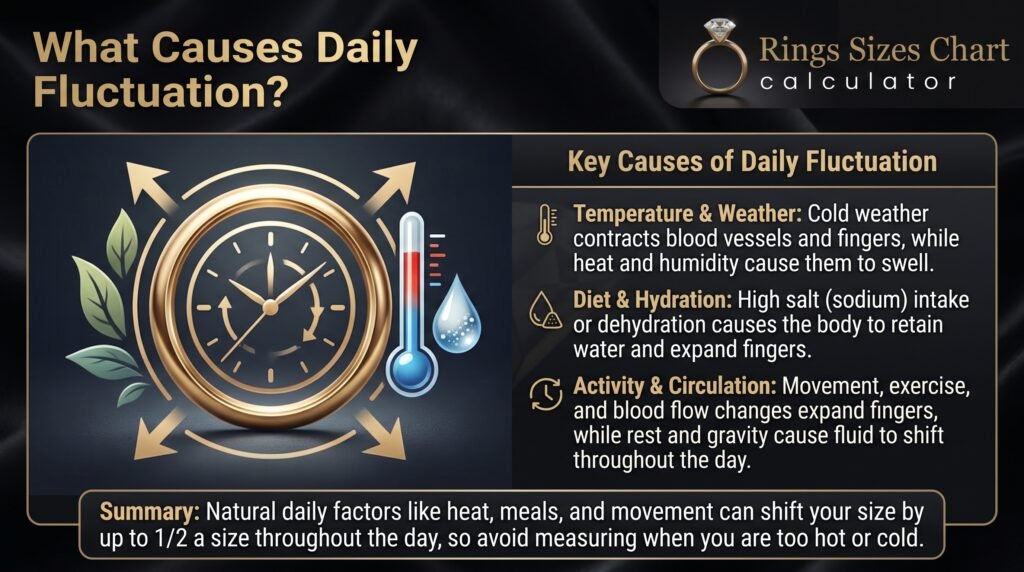
Your fingers hold fluid, and the amount shifts constantly with temperature, activity, and what you ate and drank.
Heat and cold. Heat widens blood vessels and fingers swell slightly, while cold narrows them and fingers shrink. This is the most common reason a ring that fit at breakfast feels snug after a hot walk.
Salty meals and dehydration. A high salt meal makes the body hold extra fluid, and fingers often show it first. Many people find their ring tighter the morning after a salty dinner.
Exercise. Blood flow to the hands rises during and right after a workout, so fingers often measure larger for a while afterward. Heavy lifting or gripping can add to it.
Alcohol and flights. Both tend to cause temporary swelling. Long flights combine sitting still, cabin conditions, and often salty food, so a ring that fit at departure can feel noticeably tighter on landing.
Time of day. Fingers are often a little smaller first thing in the morning and larger later in the day, though the pattern varies. Some people see the opposite, with morning puffiness that settles by afternoon.
Hormonal cycles. Many people notice a small, repeating change in ring fit tied to their cycle, usually as mild fluid retention.
Does Ring Size Change With the Seasons?
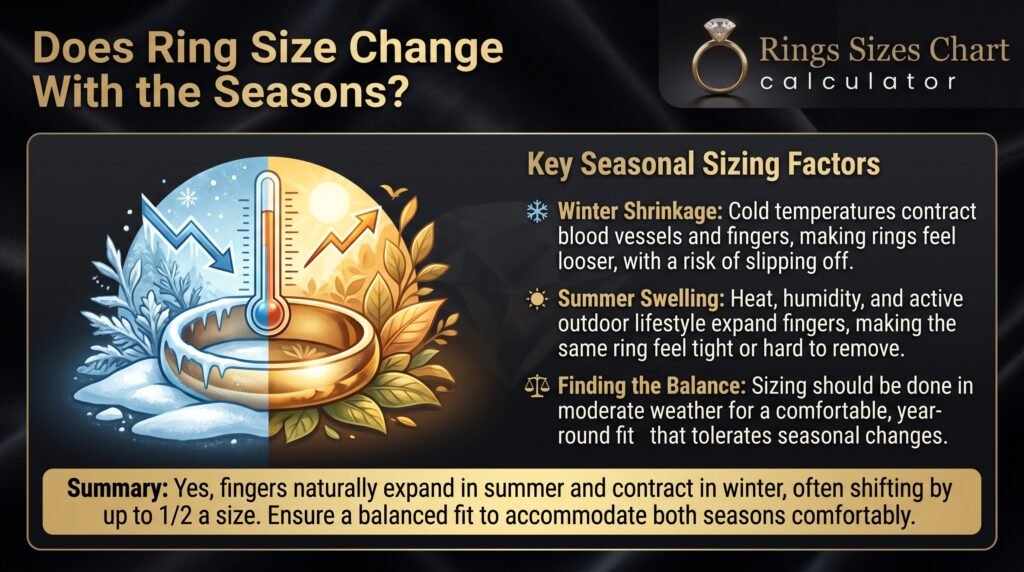
Yes, for many people. Fingers tend to run larger in a hot summer and smaller in a cold winter, with a gap of up to about half a size between the two extremes. This is why a ring bought in January can feel looser than expected in July, and the reverse.
Some people deliberately choose a fit that feels slightly snug in warm weather, knowing it settles comfortably when temperatures drop. Others size for the hottest part of the year and accept a slightly loose fit in winter. Neither is wrong, and the right call depends on your climate and how much your own fingers swing.
How to Tell Temporary From Permanent
The fastest test is time. A temporary change resolves within hours or days, and a lasting one stays put.
| Pattern | Likely Cause | What It Means |
|---|---|---|
| Tight in the evening, fine in the morning | Normal daily swing | No action needed |
| Tight after heat, flights, or salty food | Temporary fluid retention | Wait it out |
| Tight for several weeks, same all day | Possible real size change | Remeasure and monitor |
| Gradual change over months or years | Weight, joints, or age | Likely lasting |
| Sudden, painful, or one finger only | Something else | See a doctor |
If a change lasts a few weeks with no daily pattern, your finger has probably settled at a new size. Our guide on whether ring size changes with age covers the slower, lasting changes in more depth, including joint changes at the knuckle.
When Fluctuation Is Not Normal
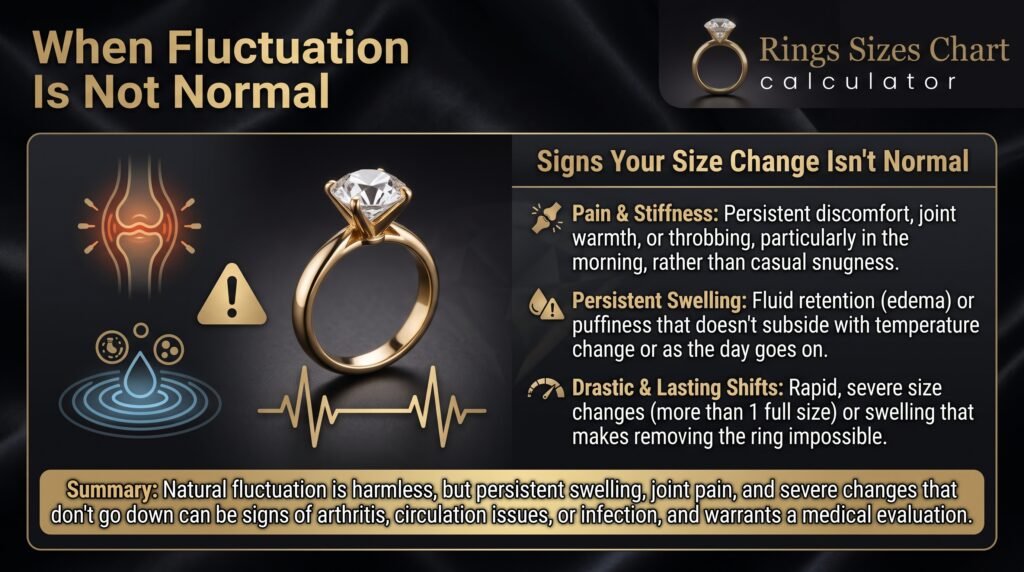
Most swings are harmless, but a few signs deserve attention. A ring that suddenly becomes very tight, swelling in one finger only, or any swelling with pain, redness, or warmth is worth a doctor’s visit rather than a jeweler’s, since it can point to something beyond ordinary fluid changes. If a ring will not come off and the finger is turning discolored or numb, treat it as urgent and get medical help rather than forcing it.
The Best Way to Measure With a Fluctuating Finger
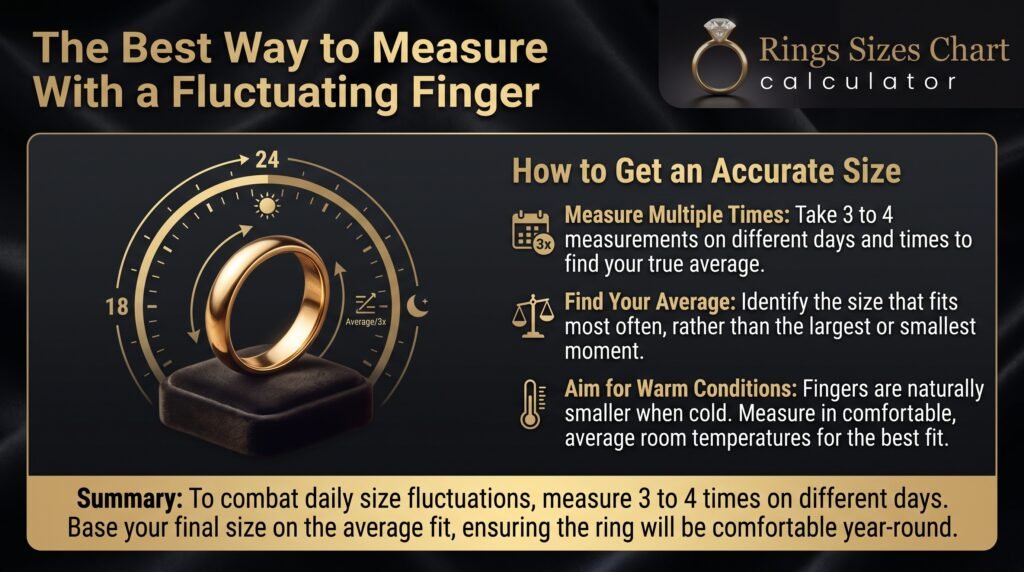
Because your finger moves through a range, a single measurement tells you only one point on it. A better method gives you the whole range.
Measure the same finger three times across one normal day: once in the morning, once in the early afternoon, and once in the evening. Do it at room temperature, away from a workout, a hot shower, or a long flight. Use the same method each time, whether that is string, paper, or a sizer. Our guide on how to measure ring size at home covers the technique, and our step by step walkthrough of measuring with a tape measure is a good option if you have one on hand.
Then compare the three readings:
- If they land within a quarter size of each other, take the middle one.
- If they spread to half a size, choose the size that fits at your afternoon reading, since that is the point where your finger sits closest to its everyday average.
- If you wear a wide band, size up a quarter size from that result, because wider bands feel tighter at the same number.
You can convert each reading instantly with our free ring size calculator, which accepts either circumference or diameter. Do not size to your single largest reading after exercise or a flight, since a ring sized to a swollen finger will spin loose the rest of the time.
What to Do If Your Ring Is Tight or Loose Right Now
Start with the cause. If the change is from heat, salt, or a flight, wait a few hours and try again rather than forcing it. A ring that is stuck can often be eased off by elevating your hand for a few minutes, then using a little soap or lotion around the band.
If the fit stays off for weeks, decide whether you need a fix. A quarter size gap is often too small to justify a resize, and our guide on whether a quarter size makes a difference helps you judge that. For a ring that runs loose, sizing beads are a reversible option, and our guide on removing ring sizing beads explains how that works if you change your mind later. If the change looks permanent, our breakdown of what resizing costs is worth reading first, and our guide on what to do when an engagement ring no longer fits covers temporary fixes versus a full resize.
Why Fingers Fluctuate Differently From Each Other
Not every finger on your hand swings by the same amount. The ring finger, middle finger, and pinky differ in size to begin with, and each responds a little differently to heat and swelling. If you wear rings on several fingers, expect each one to feel the daily change in its own way. Our breakdown of how much ring size varies between fingers shows how large the baseline gaps already are.
Frequently Asked Questions
How much can ring size change in one day?
Ring size commonly changes by a quarter to a half size over a single day, driven by temperature, activity, and fluid retention.
What time of day are fingers smallest?
For many people, fingers are smallest first thing in the morning and largest in the evening, though the pattern varies from person to person.
Why does my ring feel tight in the heat?
Heat widens blood vessels and causes mild swelling in the fingers, so the same ring feels tighter until your body cools down.
Should I resize a ring that fits differently from day to day?
Usually not. A fit that changes with the day is normal fluctuation, and resizing for it risks a ring that is too loose at other times.
Can drinking water or eating salty food change my ring size?
Yes. Salty meals and dehydration both encourage fluid retention, which often shows up first in the fingers as a tighter ring.
Is it normal for my ring size to change with my menstrual cycle?
Many people notice a small, repeating change in ring fit tied to their cycle, usually from mild fluid retention. It is common and typically temporary.
Final Thoughts
Your finger is not a fixed object, so no single measurement will describe it perfectly. Expect a quarter to half a size of movement over a normal day, a similar swing between summer and winter, and larger changes with pregnancy or lasting weight change. Measure at several points on one day, choose a size that works across most of that range, and save a resize for changes that stay put for weeks rather than hours.