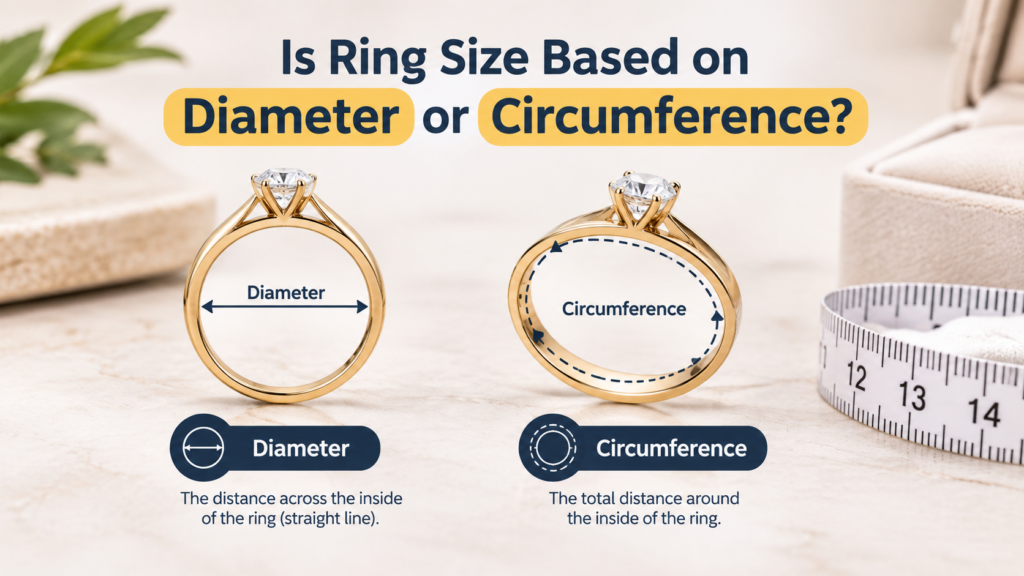
Ring size is officially based on inner circumference, the full distance around the inside of the band, not diameter, the straight line distance across it. Diameter is simply the easier of the two to measure at home, so most people end up working with it even though circumference is what actually determines the size on a chart.
Here is exactly how the two relate, the precise formula for converting between them, and why getting this right matters more than it might seem.
Circumference Is the Actual Standard
A ring wraps completely around your finger, so the measurement that determines comfort and fit is the total length of that loop, its circumference, not the distance straight across the middle. Every major sizing system, US, UK, and EU, is built around this same underlying circumference value, even though each one displays it differently on the surface.
This is also why European sizing is the most transparent about it. A European size of 52 literally means a 52mm inner circumference. The number on the chart is the measurement itself, with nothing hidden behind a separate numbering scale.
Why Almost Everyone Measures Diameter Instead
Despite circumference being the actual standard, diameter is what most people end up measuring, for a simple practical reason: it is far easier to get an accurate reading. If you already own a ring that fits well, laying it flat and measuring straight across the inner edge with a ruler takes seconds. Measuring circumference directly usually means wrapping string or a paper strip around a finger, which introduces more room for a slightly loose or slightly tight wrap to throw off the result.
Diameter converts to circumference with a straightforward formula, one every ring size chart is quietly built on:
Circumference = Diameter × π
Since pi is approximately 3.14159, a ring with an 18mm inner diameter has a circumference of about 56.5mm. Using the fuller value of pi rather than rounding to 3.14 makes a small but real difference at the edges of a size range, close to a tenth of a millimeter on an average ring, which occasionally matters if your diameter measurement already sits right on the boundary between two sizes.
Full Conversion Table: Diameter and Circumference by Size
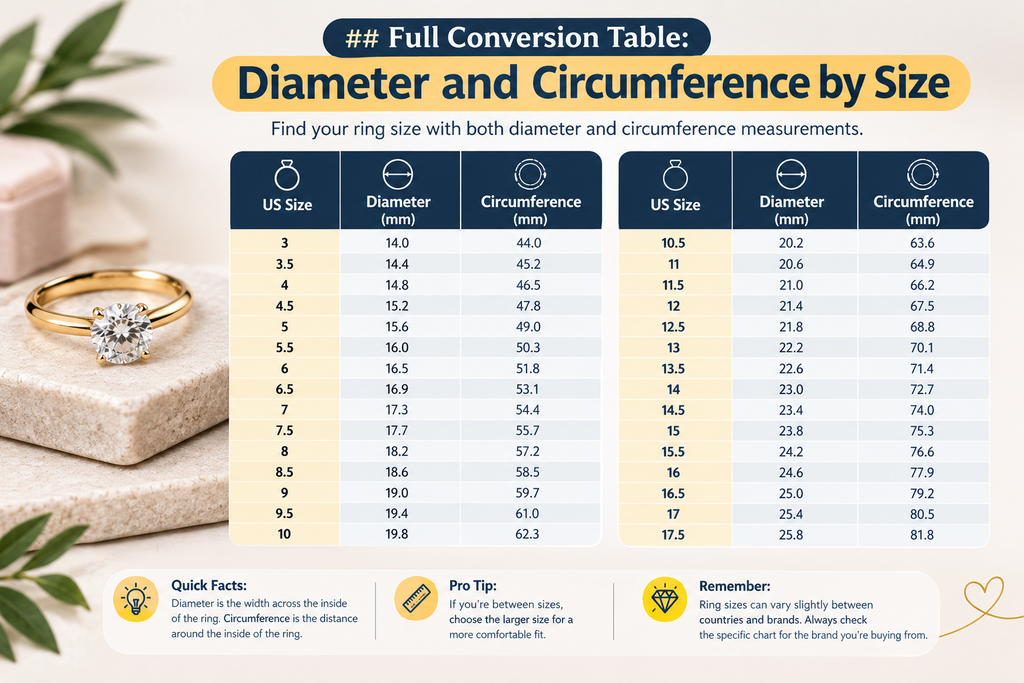
Since most charts only show a couple of example sizes, here is the complete picture across the standard adult range, so you can check your own measurement against the full table rather than a single example.
| US Size | Inner Diameter | Inner Circumference |
|---|---|---|
| 4 | 14.9mm | 46.8mm |
| 5 | 15.7mm | 49.3mm |
| 6 | 16.5mm | 51.9mm |
| 7 | 17.3mm | 54.4mm |
| 8 | 18.1mm | 57.0mm |
| 9 | 18.9mm | 59.5mm |
| 10 | 19.8mm | 62.1mm |
| 11 | 20.6mm | 64.6mm |
| 12 | 21.4mm | 67.2mm |
| 13 | 22.2mm | 69.7mm |
Notice that each full size step moves the diameter by roughly 0.8mm and the circumference by roughly 2.5mm. That gap between the two numbers is exactly why a small measuring error matters more when you are working with diameter. A slip of half a millimeter on a diameter reading represents a bigger share of the distance between two sizes than the same error would on a circumference reading.
Measuring Your Finger vs. Measuring a Ring
These two situations actually call for different measurements, even though people often use the terms interchangeably.
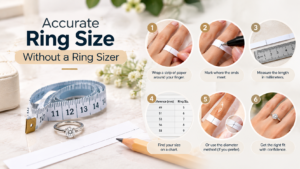
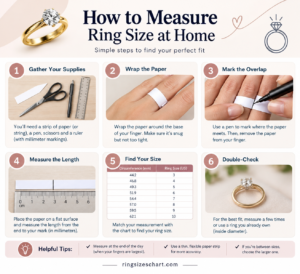
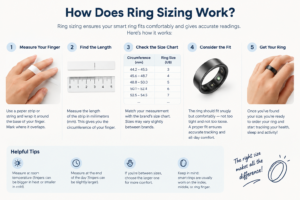
Measuring your finger directly gives you circumference. Wrapping a flexible tape, a strip of paper, or a piece of string around the base of your finger and reading the length at the overlap point is a circumference measurement, ready to compare against a chart without any conversion needed.
Measuring an existing ring gives you diameter. Laying the ring flat and measuring straight across the inside edge with a ruler or calipers gives you diameter, which then needs the formula above to become a usable circumference figure, or a direct comparison against a diameter column on a chart like the one above.
If you would rather skip the math entirely, our free ring size calculator accepts either measurement type directly and converts it instantly, and our guide on measuring ring size with tape walks through getting an accurate circumference reading on your own finger.
Why the Distinction Actually Matters
This is not just a technical curiosity. Getting diameter and circumference confused is one of the more common reasons a self measured ring order comes back the wrong size. Someone measures an existing ring’s diameter, then mistakenly compares that number directly against a chart’s circumference column, and ends up ordering a size that is noticeably too large, since circumference numbers are always larger than diameter numbers for the same ring.
Always check which column of a chart you are reading, diameter or circumference, before matching your measurement to a size. For a broader sense of where your number should typically land, our guide on the average ring size for women breaks down typical diameter and circumference ranges across common sizes as additional context.
Frequently Asked Questions
Which measurement should I trust more, diameter or circumference?
Circumference is the true standard that sizing charts are built around, but either measurement works fine as long as you compare it against the matching column on an accurate chart.
Why do some charts only show circumference and not diameter?
Circumference is the direct, official measurement, so some charts simplify by showing only that column. Diameter is included on more detailed charts mainly as a convenience for people measuring an existing ring.
Is the formula the same for every ring size?
Yes, circumference always equals diameter multiplied by pi, regardless of the specific size. The relationship between the two numbers is pure geometry and does not change across the sizing range.
Can I convert circumference back to diameter?
Yes, by dividing circumference by pi instead of multiplying. This is useful if you have a finger measurement in circumference but need to compare it against a diameter based tool or chart.
Does band width affect whether I should use diameter or circumference?
No, band width affects how a given size feels once worn, but it does not change which measurement, diameter or circumference, corresponds to which size on a standard chart.
Final Thoughts
Ring size is officially defined by inner circumference, but diameter is what most people can measure accurately at home, which is why both numbers show up on a well built chart. The formula connecting them is simple, circumference equals diameter times pi, but mixing up which column you are reading is one of the easiest ways to order the wrong size. Check which measurement you actually have before matching it to a chart, and the rest of the process is straightforward.