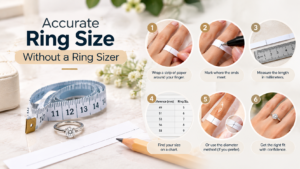
You do not need a dedicated ring sizer to get an accurate measurement. A digital caliper gets you closest to professional level precision, and a piece of string, an existing ring, or even a printed chart will all get you close enough for most purposes if used carefully. The method that works best for you really just depends on what you already have within reach.
Here is how each option ranks for accuracy, exactly how to use the two most precise ones properly, and when it is worth skipping all of them and asking a jeweler directly instead.
Accuracy Ranking: Every Method Compared
| Method | Typical Accuracy | What You Need |
|---|---|---|
| Digital caliper | Highest, often within 0.1mm | A digital caliper |
| Measuring an existing ring | Very high | A ring that already fits the target finger |
| String or paper strip | Good | String, paper, or floss and a ruler |
| Printable chart (correctly scaled) | Good | A printer and a ruler to verify scale |
| Professional jeweler | Highest overall | A visit to a jewelry store |
A digital caliper and a visit to a jeweler both tend to edge out the home methods slightly, but the gap is small when the home methods are done carefully. The real differences in accuracy usually come down to technique, not the tool itself.
Method 1: Digital Caliper (Most Precise Home Option)
A digital caliper is the most accurate tool most people can get their hands on without visiting a jeweler, and it is worth using correctly rather than guessing at the technique.
Most digital calipers have two sets of jaws, a larger outer pair for measuring the outside of an object, and a smaller inner pair, often thinner and set slightly back from the main jaws, specifically for measuring inside diameters. For ring sizing, the inner jaws are what you want.
If you are measuring an existing ring, open the inner jaws, insert them into the inside of the band, and gently expand them until they touch the inner wall on both sides evenly. Read the diameter directly off the digital display. If you are measuring your finger directly rather than a ring, calipers are less practical for this, since there is no fixed inner edge to measure against, so this method works best specifically for measuring an existing ring rather than the finger itself.
Once you have the diameter, convert it to a size using a chart, or skip the math with our free ring size calculator, which accepts diameter measurements directly.
Method 2: Measuring an Existing Ring Without a Caliper
If you do not have a caliper but do have a ring that already fits the target finger well, a ruler works almost as effectively. Lay the ring flat on a hard surface and measure straight across the inside, from one inner wall to the opposite inner wall at the widest point, not across the outer edge of the band. Read the measurement to the nearest half millimeter if your ruler allows it, since diameter differences between adjacent sizes are often less than a full millimeter.
Method 3: String, Paper, or Floss
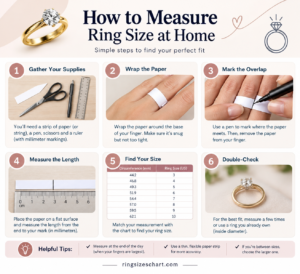
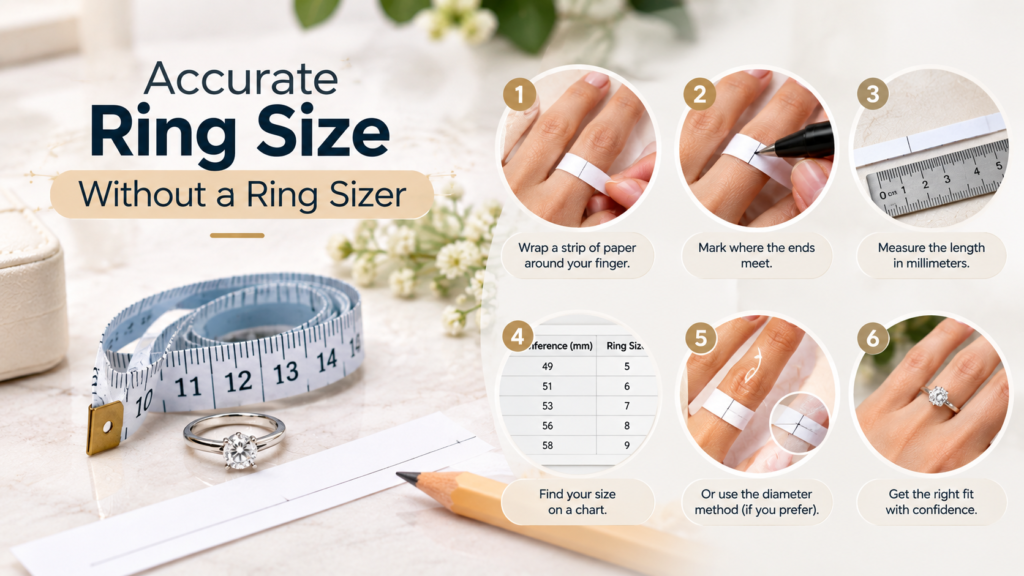
This remains the most accessible method for anyone without an existing ring or a caliper on hand. Wrap a non stretch material snugly around the base of the target finger, mark the overlap point, and measure that length against a ruler. Our full guide on how to measure ring size at home covers this method step by step, including the timing and technique details that most affect accuracy.
Method 4: A Correctly Scaled Printable Chart
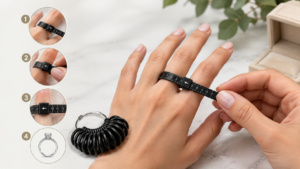
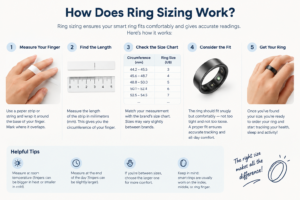
Printable charts work well, but only if your printer actually prints them at true size. Many printers default to a fit to page setting that quietly shrinks the chart by a small percentage, which is enough to shift the reading by close to half a size. Always check the reference line included on most printable charts against a real ruler before trusting the result, and reprint at 100% or actual size if it does not match. Our guide on using a ring sizer correctly covers this printing issue in more depth, along with physical sizer tools if you decide a printed chart is not precise enough for your needs.
Method 5: Asking a Professional Jeweler
If precision genuinely matters, an engagement ring, a wedding band, or anything you cannot easily return, a jeweler can measure your finger for free in a couple of minutes using professional tools and years of practiced judgment about knuckle clearance and comfort. Many jewelers will also measure for free even if you do not plan to buy from them that day, since it builds goodwill and often leads to a future sale. This option costs nothing but a short visit and removes essentially all of the guesswork from the home methods above.
Which Method Should You Actually Use
If you already own a ring that fits the target finger, measuring it, ideally with a caliper, is usually your fastest and most reliable option. If you do not, string or paper remains the most practical choice for most people, as long as you measure more than once and check the result against our diameter versus circumference guide to make sure you are reading the right number off a chart. Save a jeweler visit for anything where getting it wrong would be costly or hard to fix, like an engagement ring or a ring you are ordering as a surprise gift.
Frequently Asked Questions
Is a digital caliper actually worth buying just for ring sizing?
For a single measurement, probably not. If you expect to measure multiple people’s sizes over time, such as for gift shopping or jewelry making, a basic digital caliper is inexpensive and genuinely useful well beyond ring sizing alone.
Can I trust an existing ring’s measurement if it is slightly loose?
Only loosely. A ring that already spins or slides on the target finger will measure larger than your true comfortable size, so it is better to use a ring that fits snugly rather than one that is already a bit big.
How accurate is the string method compared to a caliper?
Done carefully, string and paper measurements land very close to caliper accuracy, typically within a quarter size. Most of the gap between the two methods comes down to technique rather than the materials themselves.
Do jewelry stores charge for measuring your ring size?
Most do not. A quick sizing is typically offered free, even if you are not purchasing a ring that day, since it is a low cost way for the store to build a relationship with a potential future customer.
What if two different methods give me different results?
Trust the more controlled measurement, typically a caliper reading on an existing ring or a careful string measurement taken multiple times, over a single quick reading from a less precise method like an uncalibrated printable chart.
Final Thoughts
You do not need a dedicated ring sizer to land on an accurate size. A digital caliper and an existing ring get you closest to professional precision, string and paper remain reliable with careful technique, and a correctly scaled printable chart works once you confirm the print size. When the stakes are high enough, an engagement ring, a wedding band, or a gift you only get one shot at, a free jeweler measurement is worth the short trip to remove any remaining doubt.