The answer depends on which “size” you mean, because people searching this question want one of two different numbers. The average engagement ring finger size for women is a US 6, and the average center stone in the US is now 1.9 carats, according to The Knot’s latest real weddings study. Most guides pick one meaning and ignore the other, which leaves half of readers without an answer.
This guide covers both, and then does the part almost nobody does: it shows how a given carat weight actually looks on a size 5, a size 6, and a size 8 finger.
The Two Meanings of Engagement Ring Size
| What You Mean | Average | What It Measures |
|---|---|---|
| Finger size (women) | US 6, about 16.5mm inner diameter | How big the band is |
| Finger size (men) | US 9 to 10 | How big the band is |
| Center stone size | 1.9 carats (US, 2025) | The weight of the diamond |
If you are buying a ring and need the finger number, start with the finger size section. If you are wondering whether your stone is big or small compared to everyone else, the carat sections are for you.
Average Engagement Ring Finger Size
The most common women’s engagement ring size is a US 6, which is a UK L and an EU 52. Most women fall somewhere between 5 and 8. Our full breakdown of the average ring size for women covers the numbers by country and by age, and it is worth reading before you assume a size for someone else.
Two cautions matter more than the average itself. First, the ring finger is rarely the same size as the other fingers on the same hand, so a size borrowed from a different finger can be off by a full size. Our guide on how much ring size varies between fingers shows the typical gaps. Second, if you are sizing for a proposal and cannot ask, measuring a ring she already wears on that finger beats any average. When you do have a measurement, our free ring size calculator converts it into US, UK, EU, and Japan sizes in one step.
Average Engagement Ring Carat Size in the US
The average center stone in the US reached 1.9 carats for couples who married in 2025, up from 1.7 carats in 2024 and 1.5 carats in 2021, based on The Knot’s real weddings study as reported by Rapaport. That is a bigger number than most older guides quote, and many still repeat a figure of 1.0 to 1.2 carats that no longer matches what couples are buying.
The jump has one main cause. Lab grown stones now account for 61 percent of engagement ring purchases, and they cost less per carat, so buyers get more stone for the same budget.
| Stone Type | Average Carat | Average Ring Cost | Most Popular Shape |
|---|---|---|---|
| Natural diamond | 1.6 | About $7,000 | Round |
| Lab grown diamond | 2.0 | About $4,300 | Oval |
| All engagement rings | 1.9 | About $4,600 | Mixed |
The takeaway is counterintuitive. The average buyer spent less in 2025 than in 2024 and still walked away with a larger diamond.
Why a Carat Is Not a Size
A carat measures weight, not width. One carat equals 0.2 grams, and how wide that weight looks on the finger depends on the cut and the shape. For a standard round brilliant, the diameter you actually see across the top works out roughly like this:
| Carat Weight | Round Diameter |
|---|---|
| 0.5 | About 5.2mm |
| 1.0 | About 6.5mm |
| 1.5 | About 7.4mm |
| 2.0 | About 8.1mm |
| 3.0 | About 9.3mm |
Notice that doubling the weight from 1 to 2 carats does not double the width. It adds only about 1.6mm. That is why the step from 1 to 2 carats looks smaller in person than the price tag suggests.
How Carat Size Looks on Different Finger Sizes
This is the part that decides whether a stone looks big or modest on a real hand. The same diamond covers a larger share of a slim finger than a wide one. Using the inner diameter of each ring size as a rough stand in for finger width, here is the approximate share of the finger covered by a round stone:
| Carat Weight | Size 5 Finger | Size 6 Finger | Size 8 Finger |
|---|---|---|---|
| 1.0 | About 41% | About 39% | About 36% |
| 1.5 | About 47% | About 45% | About 41% |
| 2.0 | About 52% | About 49% | About 45% |
| 3.0 | About 59% | About 56% | About 51% |
These are estimates, since fingers are slightly oval rather than perfectly round, but the pattern holds. A 2 carat round stone covers about half the width of a size 6 finger, which most people read as bold. On a size 8 finger, the same stone sits closer to 45 percent and reads as noticeably more modest. If your hand runs larger than average, a stone that is average by carat can look quite restrained, and that is normal, not a sign you picked too small.
How Diamond Shape Changes the Look
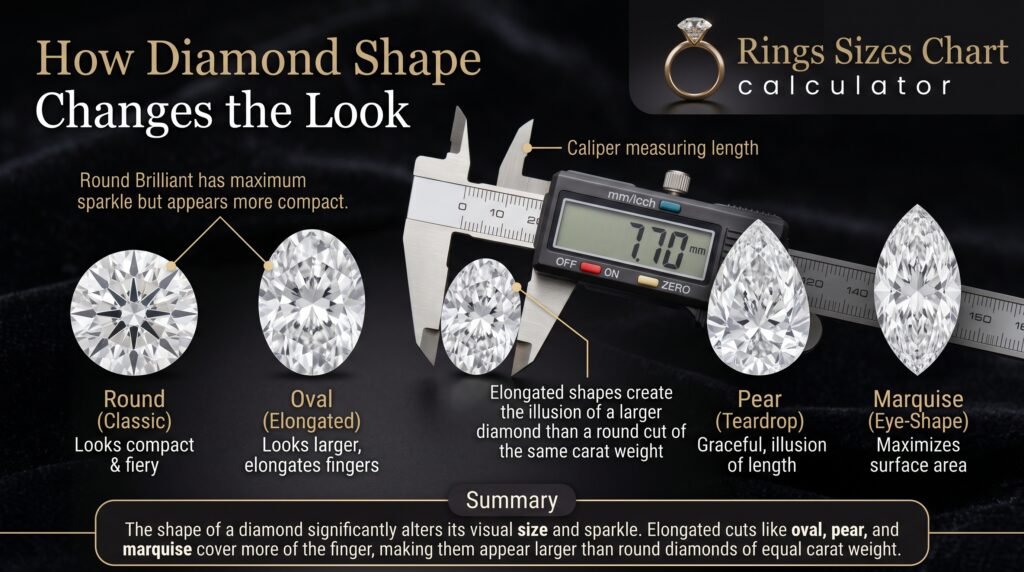
Shape moves the visual size as much as weight does. Elongated shapes such as oval, marquise, pear, and emerald spread more surface across the finger at the same carat weight, so they look larger than a round stone of identical weight. Round brilliant and cushion cuts carry more weight in depth, so they look slightly smaller face up.
This matters because lab grown buyers favor ovals while natural diamond buyers still lean toward rounds. Two couples who both bought “two carats” may be wearing stones that look noticeably different in size.
What Counts as Large, Average, or Small
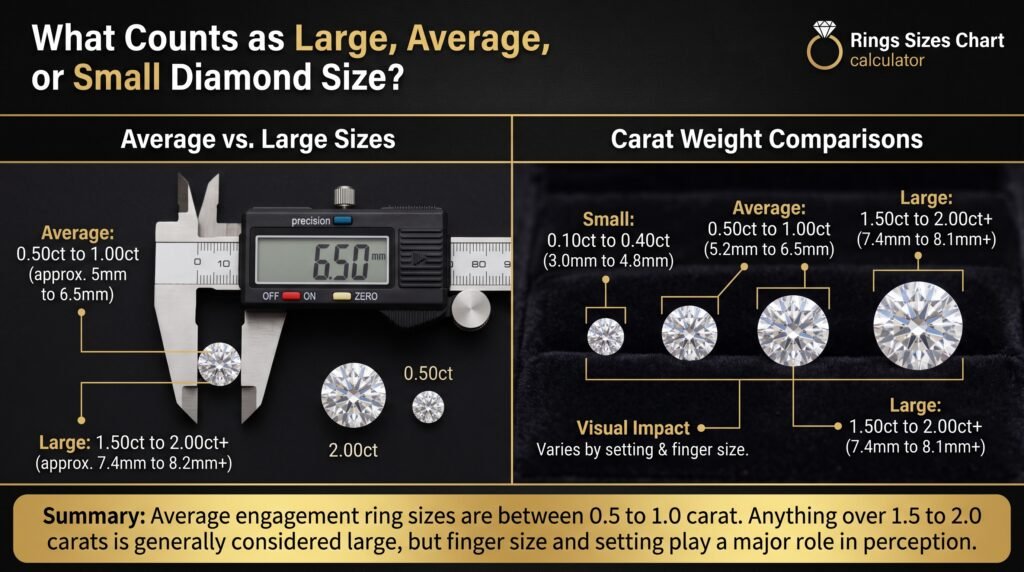
Based on the current average, a rough ladder for the US looks like this:
- Under 1 carat: Smaller than average today, though still a classic choice
- 1 to 1.5 carats: Slightly below the current average
- 1.5 to 2 carats: Right around the average
- 2 to 3 carats: Above average
- 3 carats and up: Statement territory
These labels shift with the market. A 1 carat stone was the standard ten years ago and now sits below the average, even though it looks exactly the same on the hand as it always did.
Outside the US
Averages run smaller in many other markets, where buyers tend to favor subtle stones over size, and where budgets and local jewelry traditions differ. If you are shopping internationally, finger sizing also changes by country. Our Japan ring size chart shows how a size converts across systems before you order from an overseas jeweler.
Matching the Ring to the Hand

Once the stone is chosen, fit becomes the next decision. A heavier setting or wider band can make the same size feel tighter, which is one reason two rings in the same labeled size can feel different. Our guide on whether ring sizes vary by brand explains why. If the ring stops fitting later, our guide on what to do when an engagement ring no longer fits walks through your options, and the cost of resizing is worth checking before you commit to a setting that is hard to resize.
If you are also choosing a matching band, our wedding ring size chart covers sizing for the pair.
Frequently Asked Questions
What is the average engagement ring size for a woman?
The average finger size is a US 6, which equals a UK L and an EU 52, though most women fall between size 5 and size 8.
What is the average carat size of an engagement ring?
The US average is 1.9 carats, according to The Knot’s study of couples married in 2025, up from 1.7 carats the year before.
Is a 1 carat engagement ring too small?
No. A 1 carat stone is now below the national average, but it still reads as a classic, noticeable diamond, especially in an oval or pear shape that spreads wider than a round.
Is a 2 carat engagement ring big?
A 2 carat ring is slightly above the current average. On a size 6 finger, a round 2 carat stone covers about half the finger width, which most people see as bold but not extreme.
Why are engagement rings getting bigger on average?
Lab grown diamonds, now the majority of purchases, cost less per carat, so buyers can choose a larger stone within the same or a lower budget.
Does finger size affect how big a diamond looks?
Yes. The same stone covers a larger share of a slim finger than a wide one, so a stone can look large on a size 4 hand and modest on a size 9 hand.
Final Thoughts
The average engagement ring finger size is a US 6, and the average center stone in the US is now 1.9 carats, a figure that has climbed quickly as lab grown diamonds took over the market. Neither number should decide what you buy. Finger size should come from a real measurement of the exact finger, and stone size should come from what looks right on the actual hand and fits the budget, since the same diamond reads very differently from one person to the next.