The sizing system itself is exactly the same for men and women. A US size 8 is defined by the identical inner circumference no matter who is wearing it, and the same is true across the UK, EU, and every other major sizing scale. What actually differs is the average size each group tends to land on, and the design choices, like band width, that make the same number feel different depending on the ring.
Here is how the averages compare, why the gap exists, and how much overlap there really is between the two.
The System Is Shared, the Averages Are Not
There is no separate men’s sizing scale and women’s sizing scale running in parallel. A jeweler measuring a size 9 ring uses the exact same chart and the exact same millimeter measurement regardless of who it is being made for. The difference people notice comes entirely from averages, not from the system itself.
Average Sizes by Gender
| Sizing System | Typical Women’s Range | Typical Men’s Range |
|---|---|---|
| US / Canada | 5 to 8, average around 6 | 8 to 12, average around 9 to 10 |
| UK / Australia | J to Q, average around L | P to X, average around S to T |
| EU | 49 to 58, average around 52 | 57 to 67, average around 60 to 62 |
The typical gap between the two averages works out to roughly three US sizes, which is a real, consistent pattern across most populations, though individual variation within each group is large enough that plenty of women measure above the male average and plenty of men measure below it. For a closer look at the women’s side of this range specifically, our breakdown of the average ring size for women covers country by country and age related detail.
Why the Averages Differ
A few structural factors show up consistently across most hands, though none of them are absolute rules for any individual person.
Bone and joint size. Men’s fingers tend to have wider bones and larger knuckles on average, which pushes the required ring size up. Women’s fingers tend to be more tapered and narrower through the same points.
Overall hand proportion. Average height and build correlate loosely with finger size, and since men are on average taller and larger framed, this compounds with the bone structure difference above.
Muscle and tendon development. Hands used more heavily for gripping and manual tasks over time tend to develop slightly more muscle and connective tissue around the joints, which can add to size gradually.
None of these factors is deterministic for an individual. Hand size within any group varies enormously, which is exactly why an average is only useful as a rough starting point, never a substitute for measuring the actual finger in question.
Why the Same Number Can Still Feel Different
Even when a man and a woman genuinely share the same ring size, the two rings often do not feel identical, because design differs alongside the averages.
Men’s rings are commonly built with wider bands than women’s rings, and a wider band creates more contact and more resistance against the finger, so the identical labeled size can feel snugger in a men’s style than a women’s style. Ring profile plays a role too. A rounded, comfort fit interior, more common on rings designed for daily heavy wear, slides on more easily than a flat interior band in the same size.
How Much Overlap Actually Exists
Quite a lot. Since these are averages across large groups, not fixed categories, the ranges overlap substantially in the middle. A woman measuring a size 9 and a man measuring a size 7 are both well within normal range for their respective genders, even though each sits on the opposite side of the typical average for their group. This overlap is exactly why unisex ring designs, and rings simply labeled by number rather than marketed to one gender, work perfectly well across a wide range of customers.
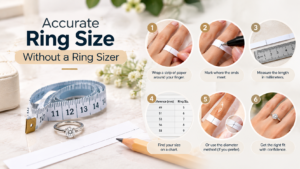
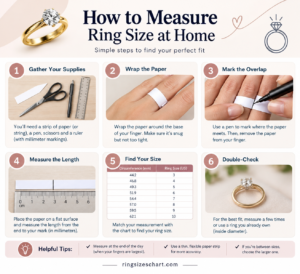
If you are buying a ring for a partner and only have a rough idea of their size, this overlap is worth keeping in mind rather than assuming a size based purely on their gender. A direct measurement, using our free ring size calculator or our guide on measuring ring size with tape, will always beat an average guess, especially for a wedding band or engagement ring that needs to fit precisely. Our wedding ring size chart is also useful if you are sizing a matching pair, since band width differences between partner rings can shift how each one should be sized even when the numbers themselves are close.
When Gender Should Not Factor Into Sizing At All
Once you have an actual measurement in hand, gender stops being relevant to the process entirely. The finger’s real circumference, the width and profile of the specific ring, and how it feels once tried on are the only things that determine a correct fit. Averages exist to help someone estimate before they have a real number to work with, not to override a measurement once one is available.
Frequently Asked Questions
Can a woman wear a men’s ring size and vice versa?
Yes. Since the sizing system itself is identical, any ring in any size can be worn by anyone whose finger matches that measurement, regardless of how the ring is marketed.
Why do men’s rings often look bigger even at the same labeled size?
Men’s rings are commonly designed with wider bands and thicker profiles, which makes the ring itself appear larger even when the inner circumference, the actual size, is unchanged.
Is there a separate sizing chart for men’s and women’s rings?
No, both use the same underlying chart and measurement system. Some retailers organize their charts by typical gender ranges for convenience, but the sizes themselves are identical.
What is a good ring size to guess if I don’t know my partner’s size?
Guessing is risky given how much individual variation exists within each average range. Borrowing a ring they already wear on the correct finger and measuring it, or asking a friend or family member discreetly, is far more reliable than assuming based on gender averages alone.
Do unisex rings use a different sizing approach?
No, unisex rings use the same standard sizing system as any other ring. The unisex label typically refers to the design and marketing of the ring rather than a different measurement approach.
Final Thoughts
Men’s and women’s ring sizes run on the exact same system, with the same numbers meaning the same measurement no matter who is wearing the ring. What differs is where each group’s average tends to land, roughly three US sizes apart, and how design choices like band width can make an identical size feel different from one ring to the next. Once you have a real measurement, averages and gender both become irrelevant, and fit comes down to the number and the ring’s design alone.