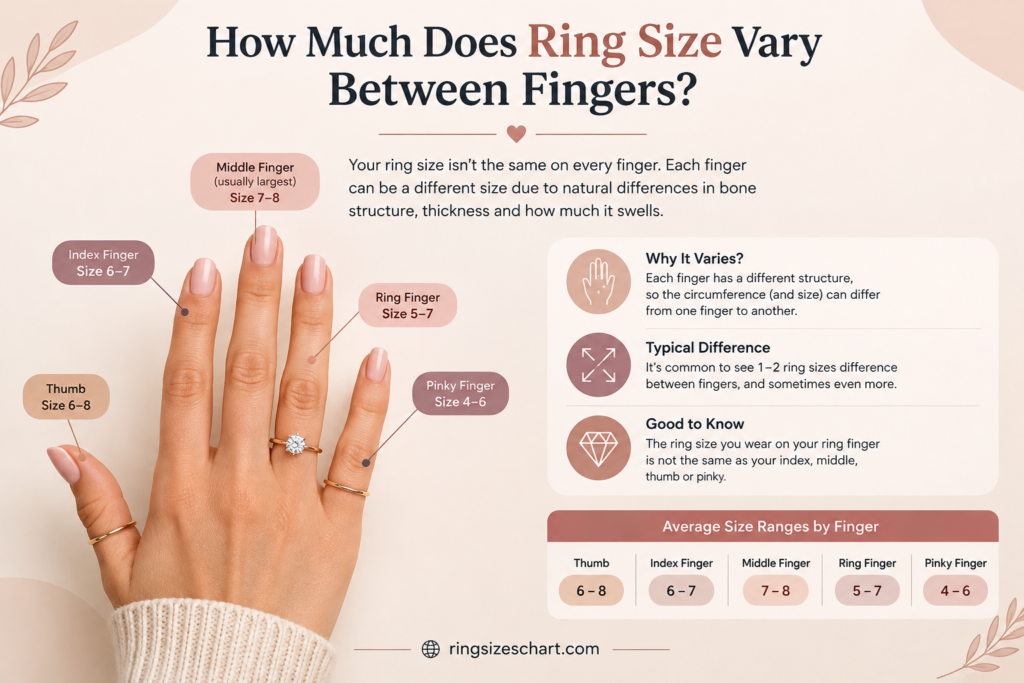
Ring size can vary by as much as one to two full sizes across a single hand, and that gap is completely normal. If a ring fits perfectly on your middle finger but slides loosely on your ring finger, nothing is wrong with the ring or your measurement. Fingers simply are not the same size as each other, even on the same hand, and the difference is usually bigger than people expect.
Here is how much each finger typically differs from the others, why the ring finger specifically tends to run smaller, and how to use this when you are guessing a size for someone else.
Typical Size Difference by Finger
These ranges are measured relative to the ring finger, since that is the reference point most people already know their size for.
| Finger | Typical Difference vs. Ring Finger |
|---|---|
| Thumb | 1.5 to 2.5 sizes larger |
| Index finger | 0.5 to 1 size larger |
| Middle finger | 0.5 to 1.5 sizes larger |
| Ring finger | Baseline |
| Pinky finger | 1.5 to 2 sizes smaller |
So if your ring finger measures a US size 7, it is common for the same hand’s middle finger to land around 7.5 to 8.5, and the pinky to come in closer to a size 5. These are typical ranges, not fixed rules. Hand shape varies enough from person to person that measuring each finger individually is always more reliable than applying an average gap.
Why the Gap Exists in the First Place
A few structural things drive this difference, and they apply to almost every hand in some combination.
Bone width. Each finger is built on a different sized bone, and the ring has to fit around that bone at its widest point, whether that is the knuckle or the base joint.
Muscle and tendon use. Fingers that see more daily use, particularly the thumb and index finger for gripping and pinching, tend to develop slightly more muscle and connective tissue around the joints over time, which shows up as a larger ring size.
Knuckle prominence. Some fingers have a knuckle that is noticeably wider than the base of the finger below it, and a ring has to clear that knuckle to go on and off, which pushes the required size up even if the base of the finger itself is fairly slim.
Why the Ring Finger Specifically Tends to Run Smaller
The ring finger generally gets less daily use for gripping and fine motor tasks compared to the thumb, index, and middle fingers, which likely explains why it is often slimmer than its neighbors on the same hand. This is one of the practical reasons engagement and wedding rings ended up on that finger in the first place, since a comparatively slim, stable finger is a sensible place for a ring meant to be worn every day without much wear from daily tasks. It is a general pattern though, not a universal one. Individual hand anatomy varies enough that some people’s ring fingers are close in size to their middle finger, or even slightly larger.
Dominant Hand vs. Non Dominant Hand
The same finger also measures differently between your two hands. Most people’s dominant hand runs a quarter to half a size larger than the non dominant hand, occasionally closer to a full size for people who do a lot of manual work or exercise heavily with one hand. This comes from the same cause as the finger to finger differences: more use generally means slightly more developed muscle and joint size over time.
This matters most when buying a ring as a gift and only having one hand’s measurement to go on, or when a ring passed down from a family member fit their dominant hand but is now being worn on someone’s non dominant hand instead.
What This Means When You Are Guessing a Size
If you already know someone’s ring size for one finger, this chart gives you a starting estimate for a different finger, but treat it as a starting point rather than a final answer. A pinky ring bought using the ring finger to pinky gap as a guide will get you close, but individual hand shape can push the real number half a size or more off that estimate in either direction.
The safer approach whenever possible is measuring the actual finger the ring is meant for, rather than converting from a different finger’s size. Our free ring size calculator makes that conversion instant once you have a real measurement, and our guide on measuring ring size with tape walks through getting that measurement accurately at home. If you are specifically trying to estimate a woman’s ring finger size as a baseline before working out the other fingers, our breakdown of the average ring size for women is a useful starting reference.
Frequently Asked Questions
Which finger is usually the largest?
The thumb is almost always the largest, both because it is naturally wider at the base and because it sees heavy daily use for gripping and pinching.
Which finger is usually the smallest?
The pinky is nearly always the smallest finger on the hand, typically one and a half to two sizes below the ring finger on the same hand.
Is the size difference the same for men and women?
The general pattern of thumb largest, pinky smallest holds for both, though the actual size numbers differ since men’s fingers are on average larger overall than women’s.
Can I use my middle finger ring size to buy a ring finger ring?
Only as a rough guide. The gap between those two fingers commonly runs half a size to a full size, so it is safer to measure the ring finger specifically rather than assume the middle finger size will transfer directly.
Does the size difference between fingers change with age?
The relative pattern usually stays the same, but the actual gap can widen slightly if joint changes affect some fingers, particularly the ones used most, more than others over time.
Final Thoughts
A ring that fits one finger and not another is not a sizing mistake, it is simply how hands are built. The thumb runs largest, the pinky smallest, and the ring finger typically sits toward the smaller end of the middle range, with a full size or more separating the extremes on a single hand. When it matters, always measure the specific finger you are buying for rather than assuming a size carries over from one finger to the next.