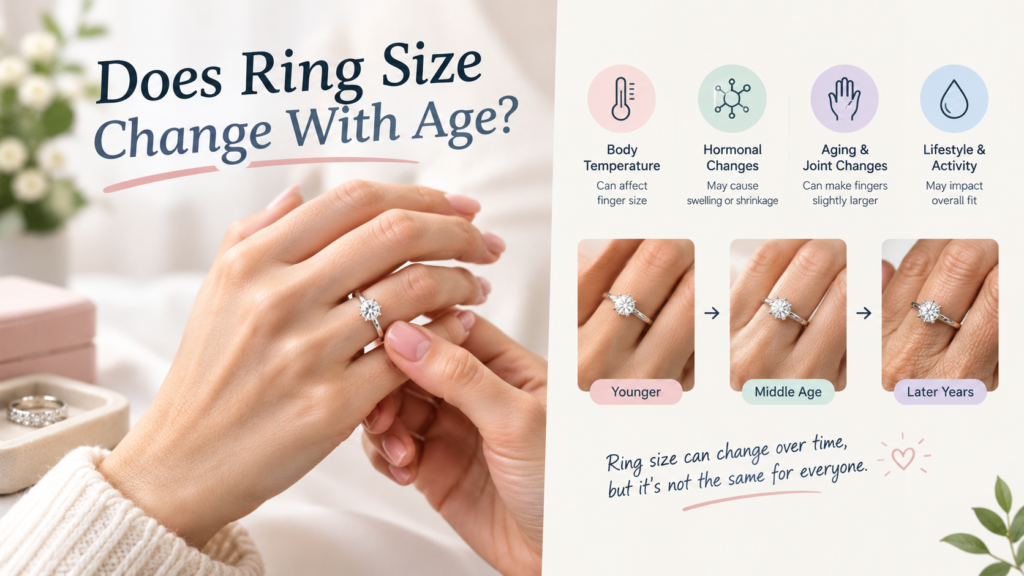
Yes, ring size commonly changes with age, but age itself is rarely the direct cause. What actually moves your finger size over the years is a small group of physical changes, skin elasticity, joint health, weight, and circulation, that simply become more common the longer you live. A twenty five year old and a sixty five year old can experience the exact same size change if the same underlying cause is present in both.
This guide breaks down what really happens to finger size as you get older, decade by decade where the pattern is clear, and how to tell a normal age related shift from something worth mentioning to a doctor.
What Actually Changes as Fingers Age
Three separate systems in the hand shift gradually over time, and each one affects ring fit differently.
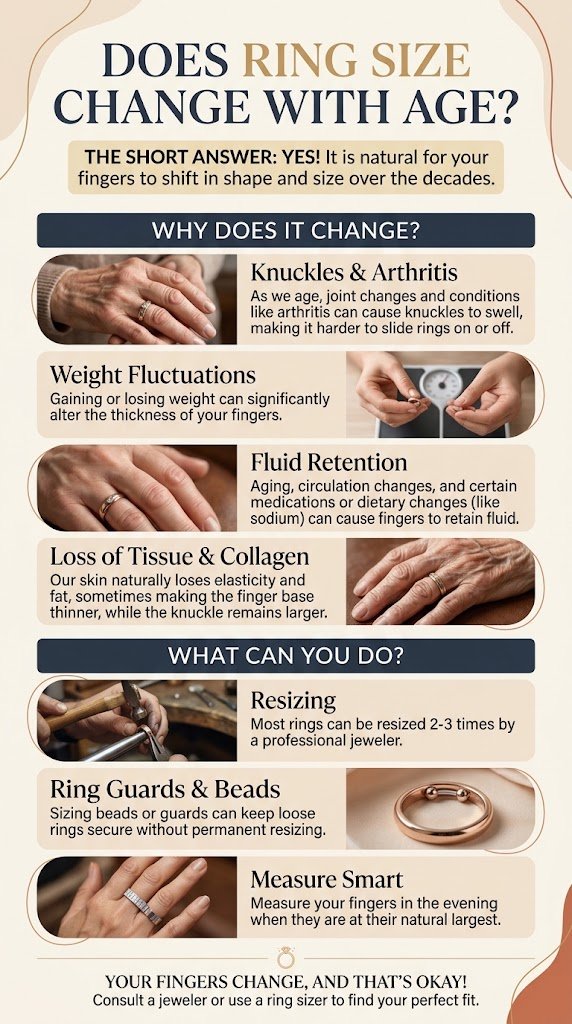
Skin and connective tissue. Skin contains collagen and elastin, proteins responsible for keeping tissue firm and able to spring back into shape. Production of both naturally slows with age, and the skin around the fingers gradually loses some of that elasticity. This does not make fingers larger on its own, but it does change how a ring sits, often feeling slightly looser at the base even when the underlying bone has not changed.
Joints and knuckles. This is the change most people actually notice. Osteoarthritis and general joint wear are common with age and tend to concentrate at the knuckles, the exact spot a ring has to pass over. The base of the finger below the knuckle may stay roughly the same size while the knuckle itself grows, which is why a ring that once slid on and off easily can suddenly get stuck at that one point.
Circulation. Blood flow to the extremities can decrease somewhat with age, and this affects how fingers respond to temperature. Older hands often swell and shrink more noticeably with heat and cold than younger hands do, which can make ring fit feel less predictable day to day even without any lasting size change.
Finger Size Changes by Decade
Not every decade brings the same kind of change, and knowing the general pattern helps you tell whether what you are noticing is typical.
| Life Stage | What Commonly Happens | Usually Temporary or Lasting |
|---|---|---|
| Twenties | Finger size is usually stable unless weight or pregnancy is a factor | Mostly stable |
| Thirties to forties | Gradual weight shifts and pregnancy related changes become more common | Mixed, often partly lasting |
| Fifties | Early joint changes may begin, especially at the knuckle | Often lasting, gradual |
| Sixties and beyond | Joint changes and reduced skin elasticity are both more common | Often lasting |
These are general patterns, not guarantees. Genetics plays a larger role in when, or whether, any of this happens than age alone does, and plenty of people keep the same comfortable ring size well into their later years.
Other Causes That Get Mistaken for Aging
Because these other factors also become more common as people get older, they are frequently lumped in with age itself when the real cause is something separate and often temporary.
Weight change. A shift of even ten to fifteen pounds is often enough to move ring size by roughly a quarter to half a size, since fat and muscle distribution at the fingers responds to overall body weight changes.
Pregnancy and hormones. Fluid retention during pregnancy is one of the most dramatic short term causes of finger swelling at any age, and it is unrelated to how old the person is.
Medication and health conditions. Certain medications and conditions that affect fluid retention, which become more common later in life, can influence finger size indirectly without being an aging effect on the finger itself.
Daily fluctuation. Heat, salt intake, hydration, and time of day all shift finger size temporarily by a small amount at any age, and this daily swing is often confused with a lasting change if someone only checks their ring occasionally.
Table: Cause vs Typical Impact
| Cause | Typical Size Impact | Temporary or Permanent |
|---|---|---|
| Normal daily fluctuation | Up to a quarter size | Temporary, resolves within hours |
| Weather (heat or cold) | Up to half a size | Temporary, resolves within hours |
| Moderate weight change | Quarter to half a size | Often lasting unless weight returns |
| Pregnancy | Half a size to two sizes | Usually mostly temporary, some lasting change possible |
| Early joint or knuckle changes | Half a size at the knuckle specifically | Usually lasting |
| Significant long term weight change | Half a size to a full size | Lasting |
Signs the Change Is Likely Age or Joint Related
A few patterns point specifically toward joint related change rather than simple fluctuation or weight shift.
The ring gets stuck at the knuckle on the way off but feels loose once past it and resting at the base of the finger. The tight spot stays consistent regardless of weather or time of day. The change has happened gradually over months or years rather than overnight. And the same pattern is often noticeable on more than one finger, not just the one wearing the ring.
If a ring becomes uncomfortable or painful to remove rather than simply snug, that is worth mentioning to a doctor rather than only a jeweler, since it can occasionally point to swelling from a cause beyond normal joint change.
What to Do If Your Size Has Genuinely Shifted
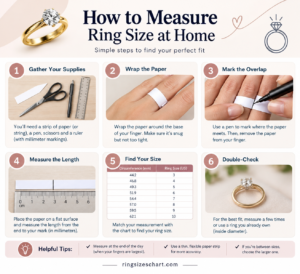
Start by confirming the actual number rather than guessing. Our free ring size calculator converts a home measurement straight into your current US, UK, or EU size, so you know exactly how much has changed before deciding what to do next.
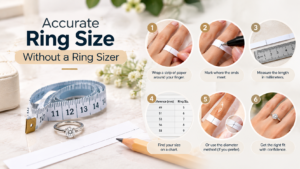
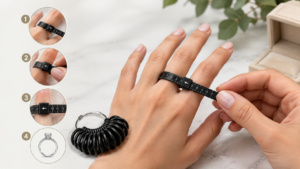
If you would rather measure with a proper tool instead of paper or string, our guide on how to measure ring size with tape covers the steps for getting an accurate reading at home. And if the ring in question is one you wear daily, it is worth reading our breakdown of the average ring size for women for context on how much natural variation is normal across different ages and body types before assuming your new measurement is unusual.
Frequently Asked Questions
At what age does ring size typically start to change?
There is no fixed age. Changes tend to become more noticeable from the forties onward as joint wear and skin elasticity shifts become more common, but weight and pregnancy can cause changes at any age.
Can ring size go back down after it increases with age?
Sometimes. If the change came from temporary swelling, weight, or pregnancy, size often returns close to its previous measurement. Changes caused by joint growth at the knuckle are usually permanent.
Does menopause affect ring size?
Many women report a small increase in ring size around menopause, likely linked to hormonal shifts and fluid retention patterns rather than the joints themselves.
Is it normal for only one hand to change size?
Yes. The dominant hand often shows joint wear and size changes slightly earlier or more noticeably than the non dominant hand due to years of additional use.
Should I resize an inherited or heirloom ring for an older wearer?
It depends on the setting and how much the size has changed. A simple band can usually be resized safely, while an intricate or heavily set piece may need a jeweler’s evaluation first to confirm what is possible.
Final Thoughts
Ring size does tend to shift as people get older, but age itself is more of a backdrop than a direct cause. Skin elasticity, joint health, weight, and circulation all move gradually in the same general direction over the decades, and any one of them can be the real reason a ring feels different than it used to. Measuring your actual current size, rather than assuming based on how long you have owned the ring, is the only reliable way to know whether it is time for a resize or simply a normal day.